Understanding FFA, Acid Value & Peroxide Value in Oils – Complete Buyer Guide 2025
🧪 Understanding FFA, Acid Value & Peroxide Value in Oils – Complete Buyer Guide 2025
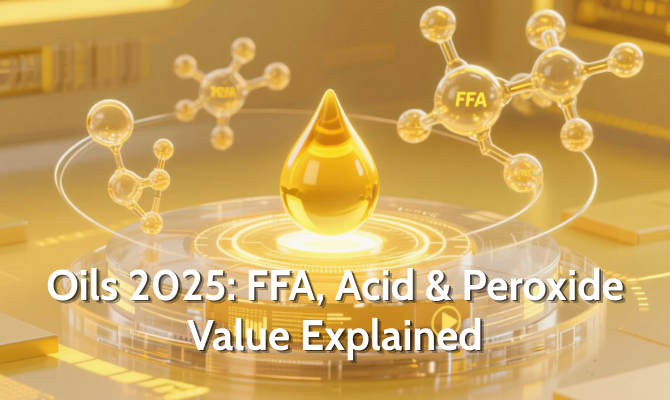
In the global oil and fat industry, quality parameters such as FFA (Free Fatty Acid), Acid Value, and Peroxide Value are some of the most important indicators when buying or evaluating oils—whether for pet food, aquafeed, biodiesel, cosmetics, food processing, or other industrial applications.
This guide helps buyers clearly understand these technical metrics and know how to choose the right oil for their production.
1️⃣ What Is FFA (Free Fatty Acid)?
.png)
FFA refers to the percentage of fatty acids that have been released from triglycerides due to hydrolysis, oxidation, or poor handling.
⭐ What FFA Tells You
- Oil freshness
- Degree of hydrolysis
- Stability during storage
- Suitability for refining or direct use
📈 Typical FFA Ranges
| Oil Type | Typical FFA Range | Interpretation |
|---|---|---|
| Refined edible oils | 0.05–0.2% | Very clean & stable |
| Crude fish oil | 2–10% | Normal range depending on source |
| High Acid Fish Oil (HAFO) | 20–60% | Suitable for fertilizer / industrial uses |
| Crude rice bran oil | 2–10% | Common for refining industries |
| Beef tallow | 1–8% | Acceptable depending on application |
In general, high FFA indicates poorer quality, increased oxidation and higher refining cost. Low FFA means fresher, more stable oils that are suitable for sensitive or premium applications.
2️⃣ What Is Acid Value?
.png)
Acid Value (AV) measures the number of milligrams of KOH required to neutralize the free fatty acids in 1 gram of oil.
It is another way of expressing FFA: the higher the Acid Value, the higher the FFA.
⭐ Typical Acid Value Ranges
| Oil Type | Acid Value Range (mg KOH/g) |
|---|---|
| Refined edible oils | < 0.1 |
| Crude vegetable oils | 1–10 |
| Crude fish oil | 3–15 |
| High Acid Fish Oil | 40–150 |
Industrial buyers use Acid Value to estimate refining cost, understand the degree of degradation, and classify the oil grade for different end uses.
3️⃣ What Is Peroxide Value?
.png)
Peroxide Value (PV) measures the level of primary oxidation in oils—the amount of peroxides and hydroperoxides formed.
It shows how fresh or oxidized the oil is.
⭐ Interpreting Peroxide Value
| PV Level (meq/kg) | What It Means |
|---|---|
| 0–3 | Very fresh, good stability |
| 3–10 | Acceptable for many industrial or feed applications |
| >10 | Oxidized, may affect smell and quality |
High Peroxide Value can cause rancid smell, off-flavors, reduced nutritional value and poor stability during storage. For pet food, aquafeed and food industries, low PV is critical to maintain product quality.
4️⃣ How These Parameters Affect Oil Applications
🐟 Fish Oil
- Low FFA + low PV → suitable for pet food & aquafeed.
- Medium FFA → acceptable for many feed applications.
- High FFA → used for fertilizer or industrial oil markets.
🥥 Coconut Oil
- Low FFA → high-quality refining and edible applications.
- High FFA → requires deeper refining before food use.
🛢️ Used Cooking Oil
- High FFA with controlled PV → commonly used as biodiesel feedstock.
🐄 Beef Tallow
- Low FFA → suitable for food or cosmetic grades.
- Medium FFA → widely used in soap manufacturing.
- High FFA → preferred in certain industrial applications.
5️⃣ How Buyers Should Read a COA (Certificate of Analysis)
When evaluating any oil, always check these key parameters on the COA:
- FFA (%) – lower is better for most applications.
- Acid Value (mg KOH/g) – should correlate with FFA.
- Peroxide Value (meq/kg) – indicates oxidation level.
- Moisture & Impurities (MIU) – high MIU leads to instability and off-odors.
- Color and odor – critical for food-grade and premium products.
Understanding these values helps buyers avoid poor-quality or overly oxidized oils and choose the right grade with the best cost–performance ratio.
6️⃣ Quick Summary Table
| Parameter | Meaning | Good Value | Bad Value |
|---|---|---|---|
| FFA | Free fatty acids (%) | Low | High |
| Acid Value | Neutralization requirement | Low | High |
| Peroxide Value | Oxidation level | 0–3 meq/kg | >10 meq/kg |
| MIU | Moisture & impurities | Low | High |
7️⃣ Conclusion
Understanding FFA, Acid Value and Peroxide Value is essential for any buyer of oils and fats—whether for pet food, aquafeed, food-grade products, biofuel, soap manufacturing or industrial use.
These parameters determine product quality, stability, refining cost and final performance. Choosing suppliers who maintain strict quality control and provide transparent COAs ensures safer, more consistent and more cost-efficient production.
8️⃣ Frequently Asked Questions (FAQ)
👉 What is FFA in oils?
FFA (Free Fatty Acid) is the percentage of fatty acids that have been released from triglycerides in the oil. It increases when the oil is exposed to moisture, enzymes or poor storage conditions. Higher FFA usually means lower quality and higher refining cost.
👉 What is the difference between FFA and Acid Value?
Both describe the same phenomenon. FFA is expressed as a percentage of free fatty acids, while Acid Value measures how many milligrams of KOH are needed to neutralize those acids in 1 gram of oil. If one is high, the other is also high.
👉 Why is Peroxide Value important?
Peroxide Value shows how oxidized the oil is. Low PV means the oil is fresh and stable. High PV indicates rancidity, off-odors and reduced nutritional value, which is especially critical for pet food, aquafeed and food-grade applications.
👉 What are good typical values for quality oils?
For refined edible or premium-grade oils, FFA is usually below 0.1–0.2% and Peroxide Value below 3 meq/kg. Crude industrial oils can have higher FFA, but PV should still be controlled to avoid strong oxidation and smell.
9️⃣ About Rich Moon Co., Ltd
Rich Moon Co., Ltd is a leading Vietnamese exporter of high-quality oils and fats, supplying global customers in pet food, aquafeed, biodiesel, soap, cosmetics and industrial sectors.
Our main product range includes:
- Fish Oil – Crude, Semi Olein, Refined Olein, Semi Stearin, Refined Stearin, High Acid Fish Oil
- Coconut Oil – Crude, Refined, Virgin Coconut Oil (VCO), Coconut Fatty Acid Distillate (CFAD)
- Beef Tallow – Crude and Refined
- Rice Bran Oil – Crude and Refined
- Cashew Shell Oil – Crude and Refined
- Sacha Inchi Oil
We focus on consistent quality, stable supply, competitive pricing and reliable documentation (COA, MSDS, COO, Phytosanitary, SGS inspection, etc.).
🔟 Contact Ms. Jade – Sales Executive
Ms. Jade – Sales Executive
📧 Email: sale1@richmoon.com.vn
📱 Phone / WhatsApp / Zalo / WeChat: +84 833 997 879
🌐 Website: https://richmoon.com.vn
🏢 Headquarters: 270/4i Le Dinh Can Street, Tan Tao Ward, Ho Chi Minh City, Vietnam
Feel free to contact Ms. Jade for quotations, COA, MSDS, packing options or sample requests.
Views: 2421




-490.png "Applications of Rice Bran Oil in Industrial Manufacturing – Complete 2025 Guide")